Life Insurance for L-1 Visa Holders in the US: 2026 Complete Guide
 Posted in Foreign Nationals last updated on May 5, 2026
Life insurance for L-1 visa holders is more accessible than most people expect and if you have been told otherwise, keep reading.
Not long ago, I worked with a client from Ireland on an L-1 visa. She had been in the US for 16 months, tried to get coverage elsewhere, and was turned away because of her visa type and length of stay. By the time she reached us, she was ready to give up.
We had her approved and covered in under two weeks.
L-1A and L-1B visa holders can qualify for term and permanent life insurance in the US, if you apply with the right carrier. The key is knowing which companies are most friendly toward foreign national applicants. That is exactly what we do before we ever submit a single form on your behalf.
This guide covers everything you need to know: the requirements, your coverage options, what mistakes to avoid, and what it will cost.
Article Summary: Yes, L-1A and L-1B visa holders can qualify for US life insurance. Most carriers require at least 10–12 months of US residency and an SSN or ITIN. Term and permanent coverage are both available, and most policies remain in force worldwide even if you move back to your home country. Working with a specialist who does pre-underwriting before submitting your application is the single biggest factor in getting approved at the best possible rate.
Table of Contents
Who This Guide Is For
This guide is written specifically for:
- L-1A visa holders (managers and executives transferred to a US office)
- L-1B visa holders (employees with specialized knowledge transferred to a US office)
- Intracompany transferees at any stage of their US assignment
- Spouses and dependents of L-1 holders (L-2 visa holders)
- L-1 holders who are actively pursuing a green card
- Anyone who has been told they do not qualify and wants a second opinion
If any of the above describes you, keep reading.
Can L-1 Visa Holders Get Life Insurance in the US?
Yes. Most L-1 visa holders can qualify for term and permanent life insurance in the United States if they meet carrier residency and documentation requirements.
The L-1 visa is actually one of the more favorably viewed visa types by insurance carriers. When a carrier reviews your application, they are trying to answer one central question: does this person have a genuine financial connection to the US, and is the coverage amount appropriate for their situation?
For L-1 holders, the answer is almost always yes. You work for a recognized multinational company. You have stable, verifiable US income. You have a US bank account and a US address. That is exactly the profile carriers want to see.
That said, not every company will approve an L-1 application. Carriers have their own internal guidelines, and they vary. Different carriers differ on how they evaluate visa type, length of US residency, country of origin, and future plans.
Some carriers are more flexible with recent arrivals, while others require a longer US residency history before offering their best health classifications.
This is why before we submit any application on your behalf, we do pre-underwriting. We review your specific situation first.
We regularly work with visa holders from India, Canada, Ireland, Europe, and many other countries who are living and working in the US on temporary visas. In our experience, the L-1 visa is one of the stronger profiles we see. Many of our clients are surprised by how straightforward the process turns out to be.
Is Life Insurance Harder to Get on an L-1 Visa?
Not necessarily, if you apply with the right company.
In some cases, it is actually easier than with other visa types. The L-1 visa is sponsored by a multinational employer. That means your employment is structured, documented, and verifiable in a way that carriers appreciate. You have a US paycheck, a US address, and a clear reason for being in the country. That combination addresses many of the concerns carriers have when reviewing foreign national applications.
The main factor that can limit your options is length. If you have been here for less than 12 months, your carrier choices are more limited. Once you reach the 12-month mark and especially the 36-month mark, more doors open, including access to the most competitive rates available.
We understand carrier guidelines and will point you in the right direction.
What Are the Requirements for L-1 Visa Life Insurance in 2026?
Here is exactly what carriers will look at when they review your application for life insurance on an L-1 visa.
US Residency
How long you have been physically present in the United States is one of the most important factors. Carriers use this to determine both your eligibility and the health rating class available to you.
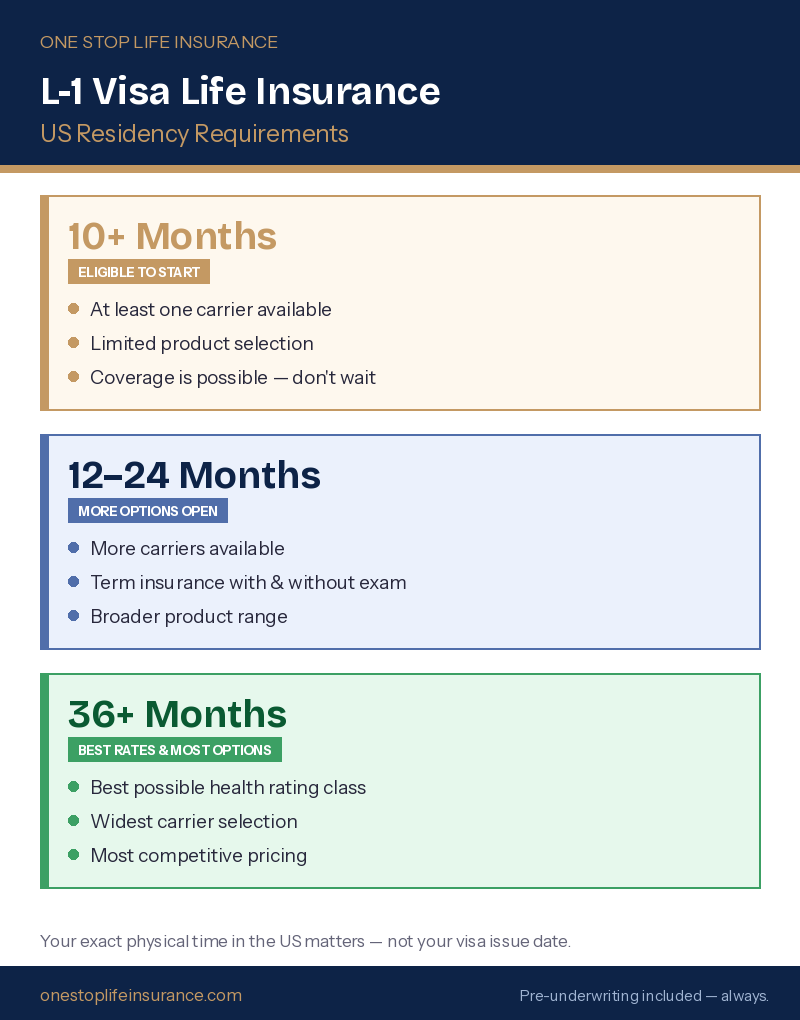
- 10+ months in the US: At least one carrier will consider your application. Options are more limited at this stage, but coverage is possible — which is exactly the situation our Irish client was in when she came to us.
- 12–24 months in the US: More carriers become available. You can access a broader range of products, including term insurance with and without a medical exam.
- 36+ months in the US: This is the sweet spot. You qualify for the best possible health rating class and the widest selection of carriers and products, including the most competitively priced options on the market.
One important note: carriers take the residency requirement seriously. We had a case, where the application was postponed, because the client was 2 weeks short of his US residency. Your exact time in the US at the time of application matters, not your visa issue date.
SSN, ITIN, and US Bank Account
You will need either a Social Security Number (SSN) or an Individual Taxpayer Identification Number (ITIN). You will also need a US bank account. The premiums must be paid in US dollars from a domestic account.
If you only have an ITIN, we can still find you coverage. Some carriers are significantly more flexible with documentation than others, and part of our pre-underwriting process is identifying the right fit for your paperwork situation.
Financial Ties to the US
Carriers want to understand why a US life insurance policy makes financial sense for you. This is sometimes called the “nexus” requirement. Examples of what qualifies: your employment with a US company, a US mortgage or rental lease, a US bank account or investment account, or a spouse and children living in the US. Most L-1 holders meet this requirement easily through their employment alone.
Intent to Stay in the US
Carriers will ask about your plans. Do you intend to remain in the US, or do you expect to return to your home country in the near future? You do not need to commit to staying permanently — the L-1 visa is by nature temporary — but companies want a general sense of your plans. Be honest. If you know you are leaving in the next 12 months, say so. Honesty on the application protects your beneficiaries if they ever need to file a claim.
Foreign Travel
Past and planned international travel is always part of the review. Carriers will ask where you have traveled recently and whether you have upcoming trips scheduled, especially to countries in higher-risk classifications. L-1 holders who travel internationally for work should be prepared to document their travel history. It is also important to disclose scheduled international trips (in the next 24 more months).
Health and Lifestyle
The same health questions that apply to any life insurance applicant apply to you: medical history, current medications, height and weight, tobacco use, and driving record. Depending on the carrier and the coverage amount, a medical exam may be required. In other cases, carriers can approve your application using existing health records. We will advise you on which approach applies to your situation before you apply.
What Documents Do You Need to Apply for Life Insurance on an L-1 Visa?
Here is what you will want to have ready when you start the process:
- Passport (current and valid)
- Current visa and any previously stamped visas in your passport
- I-94 arrival/departure record (confirms your physical time in the US)
- SSN or ITIN
- Proof of US address (lease, utility bill, or similar)
- Income verification (recent pay stubs or employment letter)
- US bank account information (for premium payments)
Some carriers may request additional documentation depending on your country of origin or the coverage amount. We will let you know exactly what is needed before you start the application — no surprises.
You can also check: Step by step guide for life insurance for visa holders.
Best Life Insurance Options for L-1 Visa Holders
As an L-1 visa holder, you have access to both term and permanent life insurance. Here is an overview of what tends to work best.
Term Life Insurance for L-1 Visa Holders
Term life insurance is the most popular choice among the visa holders we work with. It provides a fixed death benefit for a set period — typically 10, 15, 20, 30, or even 40 years — at a fixed monthly premium. It is the most affordable way to secure a meaningful amount of coverage.
Our top carriers for term life insurance for L-1 visa holders include Banner Life, Corebridge Financial, and National Life Group. Each has different strengths depending on your situation — how long you have been in the US, whether you want living benefits included, whether you prefer to avoid a medical exam, and what your budget looks like. You can review the full breakdown of each carrier in our guide to term life insurance for visa holders.
If you are unsure whether you qualify yet, we can usually tell you which carriers may work for your situation after a short conversation — before anything is submitted.
No medical exam options: Some carriers will attempt to approve your application using electronic health records, without requiring an in-person exam. This is not available to everyone. It depends on your health profile, your age, and the coverage amount. which is one of the things we assess during pre-underwriting.
Living benefits: Think of living benefits as life insurance you do not have to die to use. If you are diagnosed with a qualifying serious illness, such as cancer, a heart attack, a chronic condition. You can access a portion of your death benefit while still alive. This feature is particularly meaningful for L-1 holders whose family support network may be thousands of miles away. Not every policy includes this automatically, so it is worth asking about specifically. For a full overview, see our living benefits guide for visa holders.
Can L-2 Visa Holders Get Life Insurance?
Yes. Spouses of L-1 holders on L-2 visas can also qualify for life insurance in the US. The requirements are similar: US residency, financial ties, and documentation. Coverage amounts may be more limited depending on the carrier, but protection is available. If you are looking to cover both yourself and your spouse, reach out and we will review both situations together.
Permanent Life Insurance for L-1 Visa Holders
Permanent life insurance provides coverage for your entire lifetime — it does not expire at the end of a term. It can also build cash value over time, which you can access while still alive. Due to limited tax exemptions, many foreign nationals view and use life insurance as an estate planning tool.
Guaranteed Universal Life (GUL): This is permanent coverage designed to last a lifetime at a predictable, fixed premium. It is not focused on cash value growth — it is focused on long-term protection at the lowest possible cost. For L-1 holders who want lifetime coverage without complexity, GUL is often an excellent fit. You can learn more in our Guaranteed Universal Life guide.
Life Insurance as a Retirement Planning Vehicle (LIRP): A properly designed permanent policy can also serve as a retirement planning tool. It grows cash value on a tax-deferred basis, which can be accessed income-tax-free later. This is especially relevant for L-1 holders who may face restrictions on their 401(k) or other retirement accounts if they eventually leave the US. We cover this in depth in our retirement planning guide for visa holders.
What Happens to Your Life Insurance When You Get Your Green Card?
This is a question we get often from L-1 holders who are on the path to permanent residency and the answer is straightforward. We have also created a guide on some of the most common questions visa holders have when it comes to life insurance.
Your policy does not need to change. Once your green card is approved, your existing life insurance remains exactly as it is. Your premiums stay the same. Your coverage stays the same. Nothing is interrupted.
What does change is your options going forward. As a permanent resident, you will have access to a wider range of carriers and products. This creates an opportunity: sometimes called “laddering” to add coverage or adjust your plan at more favorable terms. But there is no requirement to do anything. Your existing policy simply continues.
This is one more reason not to wait. Securing life insurance on your L-1 visa locks in your current age and health. By the time your green card comes through, you will already have a policy in place and you can build on it from there.
Common Mistakes L-1 Visa Holders Make When Buying Life Insurance
Over the years, I have seen the same mistakes come up again and again. The full list is in our visa holder mistakes guide, but here are the ones I see most often with L-1 applicants.
Working with an agent who does not specialize in foreign nationals. This is the most costly one. Carriers have specific underwriting guidelines for non-US citizens, and they vary by company. An agent who does not know those guidelines may submit your application to the wrong carrier.
Applying before confirming your exact residency timeline. We have had situations where an application was declined because a client was just days short of the carrier’s minimum residency requirement. Always verify your exact physical time in the US before submitting anything (the informatin is available on your I-94 form).
Naming a minor as beneficiary. This comes up often with L-1 holders whose children are still living in their home country. A minor cannot legally receive a life insurance death benefit directly. The better approach is to name an adult or establish a trust. Our mistakes guide walks through how to handle this correctly.
Overlooking the financial nexus requirement. Carriers need to understand why a US policy makes financial sense for you. If your connection to the US is not clearly established in the application, it can cause delays or a decline. We make sure this is addressed properly during pre-underwriting.
Waiting for the green card. This is probably the most common and the most expensive mistake. Every year you wait, your premium goes up. If a health condition develops in the meantime, your options may become more limited. Get coverage now, at today’s age and health. Your policy will still be there when the green card arrives.
Assuming the policy will not pay out if you leave the US. Most US life insurance policies provide worldwide coverage. Your beneficiaries can file a claim from anywhere in the world, as long as you were honest on the application and your premiums are current.
How Much Does Term Life Insurance Cost for L-1 Visa Holders?
The cost of term life insurance for L-1 visa holders is determined by the same factors as for any applicant: your age, your health, the coverage amount, and the length of the term. Below are sample monthly rates to give you a general sense of what to expect.
If you are unsure whether your situation qualifies, reach out before worrying about the numbers — we can usually give you a directional answer very quickly.
| Age | Coverage Amount | Term | Estimated Monthly Rate |
|---|---|---|---|
| 30 | $500,000 | 20 years | ~$20–$28/mo |
| 35 | $500,000 | 20 years | ~$25–$35/mo |
| 35 | $1,000,000 | 20 years | ~$40–$55/mo |
| 40 | $500,000 | 20 years | ~$38–$52/mo |
| 40 | $1,000,000 | 20 years | ~$65–$90/mo |
Sample estimates based on excellent/preferred health. Individual rates vary. Subject to carrier underwriting.
When you reach out to us, we will ask a few questions about your situation and give you real numbers, not a ballpark, but actual rates for your age, health, and coverage needs, from the carriers most likely to approve you.
FAQ: Life Insurance for L-1 Visa Holders
Can L-1 visa holders buy life insurance before getting a green card?
Yes, absolutely. You do not need a green card to qualify for life insurance in the US. L-1 visa holders can access term and permanent coverage now. Waiting for permanent residency is one of the most common and most costly mistakes we see.
Can L-1 visa holders get no-medical-exam life insurance?
Yes, in many cases. Some carriers will attempt to approve your application using electronic health data, without requiring an in-person exam. Whether this is available to you depends on your age, health profile, and the coverage amount you are applying for. This is one of the things we determine during pre-underwriting before your application is submitted.
Can I keep my US life insurance if I move back to my home country?
In most cases, yes. Most US life insurance policies provide worldwide coverage. As long as your premiums are paid from a US bank account and you were truthful on your original application about your plans, the policy remains in force. Your beneficiaries can file a claim from anywhere in the world.
Does life insurance stay active if my L-1 visa expires?
Your policy does not automatically cancel if your visa expires or your status changes. As long as premiums continue to be paid from a US bank account, the coverage stays in force. That said, some carriers may have specific provisions around extended foreign residency, so it is worth reviewing your policy terms with us before that situation arises.
Do I need a Social Security Number to apply for life insurance on an L-1 visa?
No. Many carriers accept an ITIN in place of a Social Security Number. If you only have an ITIN, we will identify the carriers most flexible with your documentation during pre-underwriting, so your application goes to the right company from the start.
Can L-2 visa holders also get life insurance?
Yes. Spouses of L-1 holders on L-2 visas can qualify for coverage in the US. Requirements are similar, and we can review both applications together if you are looking to protect your whole family.
Key Takeaways
- L-1 visa holders can qualify for life insurance in the US
- Most carriers require 10–12 months of US residency to start; 36+ months unlocks the best rates
- Both term and permanent life insurance are available
- Some carriers offer no-medical-exam options for qualifying applicants
- Most policies remain active even if you move abroad, as long as premiums are paid
- Working with a specialist who does pre-underwriting before you apply significantly improves your approval odds
Conclusion
Life insurance for L-1 visa holders is more accessible than most people expect. The L-1 visa is viewed favorably by top-rated carriers. You have real options: competitive term life insurance for L-1 visa holders, no-exam pathways, living benefits, and permanent coverage for long-term planning.
The earlier you act, the better your rate. Your premium is locked in at the age and health class you qualify for today. Your policy will stay in force through visa renewals, job changes, and eventually your green card. Do not wait for the perfect moment. The best time to get coverage is now.
When you reach out, we will start with pre-underwriting. We will review your situation before anything is submitted, so we know exactly which carrier is the right fit for you. That is how we got our Irish client covered in under two weeks, and it is how we will work for you too.