Life Insurance for Indians on H1B Visa (and F1, H4, OPT): 2026 Complete Guide
 Posted in Foreign Nationals last updated on May 1, 2026
If you’re an Indian living in the U.S. on an H1B visa, you’ve probably heard conflicting advice about life insurance, that you need a green card, have to wait years, or may not qualify at all. The reality is much simpler.
Indians on H1B visa can get life insurance in the U.S., often with high coverage amounts, competitive rates, and approval in as little as a few days. Your eligibility is based on factors like income, time in the U.S., and health, not your citizenship status.
In this 2026 guide, I’ll walk you through how life insurance for Indians on H1B visa actually works, who qualifies, how much coverage you can get, what it costs, and how to apply the right way the first time.
Article Summary
Indian citizens on H1B, F1, H4, and OPT visas can qualify for US term life insurance up to of $5M+ of coverage. Eligibility is based on six core factors (time in US, income, intent to stay, health, travel, visa duration), not your visa status alone, and no-exam options mean many applicants can be approved in 48 hours without bloodwork.
Table of Contents
Life Insurance for Indians on H1B Visa: Eligibility and Requirements
Indians on H1B visa can qualify for U.S. life insurance without a green card. Most applicants are approved based on income, time in the U.S., and health, with coverage available up to $5M+.You do not need US citizenship. You do not need to have lived in the US for five years.
What you do need: a valid visa ( including H1B, F1, H4, H4 EAD, OPT, L1, L2, O1, and TN ), a US address, typically a Social Security Number (SSN) or Individual Taxpayer Identification Number (ITIN), US income or household income, and reasonable health. Some Insurers underwrite you based on risk, not passport.
This is why it is important to apply with the right carrier. Your eligibility will come down to factors like how long you’ve been in the US, your income, your health, and how much time is left on your visa, not where you were born.
We specialize in life insurance for foreign nationals. Our goal is to match you with the carrier that will offer you the best rates and the easiest application process. We take the right to pre-underwrite and understand your objectives in order to make our recommendation for next steps.
Life Insurance by Visa Type: F1, H1B, H4, OPT
Eligibility varies meaningfully by visa. Here’s how each visa category typically works for Indian citizens:
F1 student visa
F1 students can qualify for US term and permanent life insurance. Having F1 visa will limit options, as not many carriers are open to offer coverage to international students. We have created a comprehensive guide on life insurance for international students.
H1B visa
H1B is the most straightforward category. You’re working in a specialty occupation, you have an SSN, you have US income, and you typically have 3 years of visa approval remaining. Several US insurers cover H1B applicants routinely, and you can qualify for coverage up to $5M+ depending on income.
It is important to apply with the right carriers, as not every company will offer all portfolio of products to foreign nationals or may not assign the best health class available. We dedicated a separete guide on the best term life insurance for H1B visa holders.
H4 visa with EAD / OPT
H4 spouses with an Employment Authorization Document (EAD) are usually approved on their own employment income and treated similarly to H1B applicants. Coverage is typically capped at 10–20× your annual income. H4 EAD holders should apply under their own name, not the H1B spouse’s policy, to own the coverage directly.
H4 visa without EAD
H4 spouses without an EAD are eligible but underwritten on household income. In other words, the H1B spouse’s income determines coverage capacity. Standard insurers will typically approve $500K–$1M; specialty insurers familiar with Indian H4 applicants can go higher. The H4 spouse should almost always have their own policy in addition to the H1B spouse’s.
L1, L2, O1, TN
L1 intra-company transferees and O1 extraordinary ability visa holders are typically treated like H1B. L2 spouses with EAD are treated like H4 EAD. TN visa holders (typically Canadian/Mexican) follow similar H1B underwriting but don’t commonly apply to Indian citizens.
The 6 Eligibility Factors Insurers Evaluate When it Comes to life Insurance for Indians
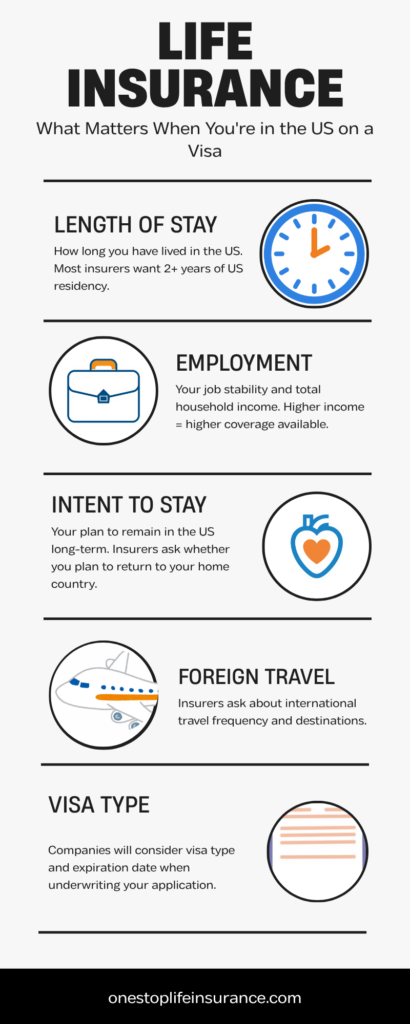
Your visa type matters, but it’s not the only thing insurers look at. Here are the six factors that determine whether you’ll be approved and what ratings will the company assign.
1. Time spent in the US
Most standard insurers want at least 2 years of continuous US residency. Shorter residency (less than 2 years) moves you into specialty-insurer territory, where coverage is available but rates may be slightly higher. If you’ve been in the US 5+ years, you’ll have access to the full standard market.
2. Employment and household income
Insurers use income to determine how much coverage you’re eligible for – typically capping total coverage at 10–20× your annual income (higher multiples for younger applicants, lower for older). For H4 applicants without an EAD, household income is used, so your H1B spouse’s income factors into your approved coverage amount.
3. Intent to stay in the US
During underwriting, you’ll be asked about your plans to remain in the US. Insurers aren’t trying to disqualify people who may eventually return to India. They’re evaluating the likelihood that the policy will be in force in the US over the 20- or 30-year term. Honest answers are critical: saying you plan to stay when you’ve already booked a one-way ticket home is the kind of misrepresentation that can void a policy later.
4. Health and lifestyle
Medical history, tobacco use, BMI, blood pressure, cholesterol, and hobbies (scuba, motorcycling, private aviation) all factor into your rate class. Non-smoker Indian applicants in their 30s in good health typically qualify for Preferred or Preferred Plus rate classes, the best available pricing tiers. Companies are considering pre-existing conditions and they are looking for stability and control.
5. Foreign travel
Insurers ask about international travel frequency and destinations. Routine trips to India (1–2 per year, 2–4 weeks each) are fine and typically don’t affect eligibility. Extended stays (3+ months per year) or travel to countries the US State Department flags with travel advisories (Level 3 or 4) will require specialty underwriting. Please note, it is very important to be transparent and disclose foreign travel as it affects your life insurance.
6. Visa expiration date
Some insurers want to see a minimum of 12–18 months remaining on your current visa at the time of application. If your H1B is close to expiring and extension is pending, apply after the extension is approved to access the broadest insurer pool.
Life Insurance Options for Indians on H1B Visa (Term vs Permanent)
Three variables determine your coverage options: policy type, coverage amount, and term length.
Policy types available to visa holders
Term life insurance is the most common and most affordable option for Indian visa holders. You pay a fixed premium for a set number of years (typically 10, 15, 20, or 30), and if you pass away during that term, your beneficiary receives the full coverage amount tax-free. If you outlive the term, coverage ends. Term is what 90%+ of our H1B clients choose.
Permanent life insurance (whole life, universal life, indexed universal life) builds cash value over time and lasts for life. There are various different products, based on the clients needs. Some plans offer lifelong protection with the option for a full return of premium. In addition, some plans can be designed to supplement retirement planning.
How Much Life Insurance Can Indians on H1B Visa Get?
| Visa Type | Typical Coverage Range |
|---|---|
| F1 (with US income) | $100K – $500K |
| F1 on OPT / STEM OPT | $250K – $1M |
| H1B | $500K – $5M+ |
| H4 with EAD | $500K – $2M |
| H4 without EAD | $250K – $1M |
| L1 / O1 | $500K – $5M+ |
Most Indian H1B clients qualify for $1M–$3M of coverage. On average, this coverage is enough to replace 10–15 years of income. It can be also used to pay off a mortgage, fund children’s education through graduate school, and leave a buffer for the surviving spouse to relocate if needed.
What Term Length Should Indians on H1B Visa Choose?
There’s no one-size-fits-all answer here, every situation is different.
That said, most Indian clients I work with on H1B, F1, H4, or OPT visas tend to choose a 25 to 30-year term. Not because it’s “standard,” but because it usually lines up with what actually matters, protecting income during the years your family depends on you the most.
When we go through this together, I typically guide clients to structure coverage so it lasts until their youngest child is around 25. By that point, they’re either financially independent or very close to it, which is when the need for life insurance naturally starts to decrease.
For some, a shorter term like 10 or 15 years can still make sense, especially if kids are older or retirement is closer. It really comes down to your timeline, your family, and what you’re trying to protect.
Life Insurance With or Without a Medical Exam for Indians on H1B Visa
You have two paths to approval: traditional (with exam) and accelerated (no exam).
With medical exam (traditional underwriting)
A licensed paramedical examiner comes to your home or office, No cost to you, and collects height, weight, blood pressure, a blood sample, and a urine sample. The insurer will review the results plus your medical records, and issues a decision in 3–6 weeks.
Best for: Applicants wanting maximum coverage ($3M+), applicants in their 40s+, or applicants with any medical complexity where the exam result might improve the rate (e.g., well-controlled cholesterol or blood pressure).
Without medical exam (accelerated underwriting)
Several insurance carriers are actively trying to approve more applications without the need of a medical exam. If needed, they will request a copy of your medical records and will accept recently completed lab results. Not having to complete a medical exam, significantly speeds up the application process and you can receive a decision within days or a few weeks of applying.
Best for: Healthy applicants under 50 wanting to get covered today rather than in 6 weeks. About 70% of our Indian H1B clients now use accelerated underwriting.
Which should you pick?
| Priority | Recommended Path |
|---|---|
| Speed (covered in 48 hours) | No-exam accelerated |
| Maximum coverage ($5M+) | With exam |
| Best possible rate, healthy | Either plan |
| Pre-existing condition | Depends on the condition and history |
| Scheduling difficulty | No-exam |
We will do pre-underwrting and will evaluate your situation to present you with best available options.
Cost of Life Insurance for Indians on H1B Visa (2026 Rates)
Monthly premium estimates for a healthy non-smoker Indian H1B holder, Male, 20-year term, Preferred rate class:
| Age | $500K Coverage | $1M Coverage | $2M Coverage |
|---|---|---|---|
| 25 | $19/mo | $31/mo | $57/mo |
| 30 | $21/mo | $34/mo | $63/mo |
| 35 | $22/mo | $39/mo | $74/mo |
| 40 | $31/mo | $54/mo | $103/mo |
| 45 | $46/mo | $90/mo | $176/mo |
- Please note that the actual rate may depend on the carrier selection, age, health and lifestyle. For accurate up to date rates, simply complete the quote form on the page.
How Life Insurance Payouts Work for Indians on H1B Visa
The death benefit from a U.S. life insurance policy is typically paid out tax-free to beneficiaries and is designed to provide a smooth, reliable payout when your family needs it most.
For Indian families on H1B, F1, H4, or OPT visas, the key focus should be on structuring the policy correctly from the start:
- Make sure your beneficiary designations are clear and up to date, typically a spouse as primary and children as contingent
- If your family is split between the U.S. and India, think through where the funds would be most useful and accessible
- Choose a coverage amount that can fully protect your family, including major obligations like income replacement or a mortgage
Everyone’s situation is a little different, so the goal is to set this up in a way that’s simple, predictable, and works no matter where life takes you.
Is Life Insurance for Indians on H1B Visa Portable to India?
This is the question Indian H1B clients ask most often. The short answer: your US policy stays in force, as long as the policy remains associated with a US address and the premiums are paid out of a US bank account.
Specifics:
- The policy doesn’t cancel when you leave the US. US insurers don’t monitor your visa or residency status post-issue.
- You need to maintain a US bank account.
- If you are planning to move to India within 2 years of applying for insurance, you need to disclose that on the applictaion (12 months for some states). Life insurance carriers will ask about foreign travel and intend to foreign residency on the applictaion.
This is why many Indian H1B families choose to keep their U.S. life insurance even after moving back home. It’s fully portable, so your coverage stays in place no matter where you live. On top of that, U.S. policies are often preferred for their predictability and strong regulatory oversight, giving families more confidence in how the policy performs and pays out over time.
Common Mistakes Indian Applicants Make When Buying Life Insurance
Applying through the wrong insurance company.
Many carriers will either decline H1B applicants outright or not offer the best term available. Working with an independent broker who represents 20+ insurers (including specialty foreign-national insurers) avoids wasted applications.
Understating foreign travel.
Don’t say “no travel to India” on the application when you clearly travel annually. The MIB and visa stamp records are easy to cross-check, and material misrepresentation voids the policy.
Waiting until the H1B extension is pending.
Apply after the extension is approved or before you’re within 12 months of expiration. Unfortunatly, we have worked a number of clients who decided to wait, only to find out that the were now not eligible due to other factors (health or lifestyle).
Skipping the H4 spouse’s own policy.
A $1M policy on the H1B spouse doesn’t protect the family if the H4 spouse passes away. It is a common mis-belive that a non-working spouse does not need to have life insurance.
Buying only an Indian policy.
LIC, HDFC, and Tata AIA policies are denominated in INR and typically pay out in INR. If your family’s US expenses (US mortgage, US tuition) will need to be covered, a US-dollar policy is the right hedge.
How to Apply for Life Insurance as an Indian on H1B Visa (Step-by-Step)
- Get an instant quote to see your rate range across 20+ insurers (takes 2 minutes, no SSN or commitment required).
- Choose term length and coverage amount based on your dependents, mortgage, and income replacement needs.
- Decide on exam vs. no-exam path based on how fast you need coverage.
- Complete the full application (30–45 minutes, most questions are about health and foreign travel).
- Sign the Medical Information Bureau authorization – standard for all US policies.
- Schedule the paramed exam if you chose traditional underwriting (optional).
- Review the approval offer – the insurer issues a rate class and final premium.
- Sign and pay the first premium – coverage is in force the day you pay.
Frequently Asked Questions
What happens to my US life insurance if I leave the country?
Your policy stays active as long as you continue paying the premiums. US life insurance is portable, which means you can keep your coverage even after moving back to India. The insurer does not cancel your policy just because your visa status changes.
Can Indian students on an F1 visa get life insurance?
Yes, but options are more limited compared to H1B holders. Most insurers look for at least some U.S. residency history, a valid visa, and often U.S.-based income or financial ties. If you’re on OPT, your options typically increase.
Do Indian H1B visa holders need a medical exam for life insurance?
Not always. Many insurers offer no-exam life insurance for Indian H1B, H4, and some F1 visa holders. If you’re healthy and under a certain age, you may be approved based on your application and medical records without completing bloodwork.
Can Indians on H1B visa get life insurance with living benefits?
Yes. Some insurers offer life insurance for Indians on H1B visa with living benefits, also known as accelerated benefit riders. These allow access to part of the death benefit if diagnosed with certain serious health conditions, depending on the policy.
What is the best type of life insurance for Indians on H1B visa?
For most Indian visa holders, term life insurance is the most popular option because it’s affordable and provides high coverage during key earning years. The right policy depends on your goals, family situation, and how long you need coverage.
How much life insurance can Indian visa holders get in the U.S.?
Most Indian visa holders qualify for coverage between $250,000 and $5M+, depending on income, age, and visa type. H1B professionals often qualify for $1M to $3M or more, while students and H4 applicants may have lower starting ranges.
Can Indian visa holders apply for life insurance without an SSN?
In some cases, yes. Certain insurers accept an ITIN instead of a Social Security Number, though options may be more limited. Working with the right carrier is key to getting approved in this situation.
How long does approval take for life insurance for Indians on H1B visa?
Approval can take anywhere from 48 hours to a few weeks. No-exam applications are often approved within days, while traditional applications with a medical exam may take 3 to 6 weeks.
Final Thoughts: Choosing the Right Life Insurance for Indians on H1B Visa
If you’re an Indian citizen in the US on H1B, F1, H4, or OPT, you almost certainly qualify for US term life insurance, if you apply with the right company. Your visa status alone doesn’t decide your eligibility; insurers underwrite based on the six factors covered above (time in US, income, intent to stay, health, travel, visa duration). Coverage options range from $250K for F1 students to $5M+ for H1B professionals, and no-exam paths mean many healthy applicants are covered within 48 hours. The biggest mistake Indian applicants make is applying with the wrong coverage. If coverage is the goal, the right time to lock it in is now, while you’re healthy and your visa has time left on it.