Lifetime Coverage for Visa Holders: 6 Benefits
 Posted in Foreign Nationals last updated on February 2, 2026
Looking for lifetime life insurance coverage as a visa holder – but don’t want to pay whole life premiums? You’re not alone. Many non-US citizens assume whole life or IUL are their only options for permanent coverage. But there’s a lesser-known alternative that offers long-term protection at a fraction of the cost: Guaranteed Universal Life (GUL).
In this article, we’ll break down what lifetime coverage means, why it can be a smart move for visa holders, and which visa types may qualify. Most importantly, we’ll show you how to secure affordable lifetime coverage for visa holders without the complexity or high premiums of traditional whole life insurance.
Quick Summary:
Lifetime life insurance for visa holders provides permanent coverage that can remain valid even if you move abroad, when properly structured. Guaranteed Universal Life insurance offers lifelong protection at a lower cost than whole life.
What we will cover
If you have any questions or would like us to review your personal situation, simply reach out to us. We specialize in life insurance for foreign nationals and will be able to match you with the best life insurance carrier for you.
What Is Lifetime Life Insurance for Visa Holders?
Lifetime coverage is a type of life insurance whose main focus is providing lifelong guaranteed coverage. It is a guaranteed universal life insurance. It is straightforward insurance offered at a lower cost compared to whole life. It is often called “lifetime term insurance,” and it is guaranteed to last up to age 100 or even age 121 (you as a client get to decide how long the plan is to be guaranteed).
Lifetime coverage is a good fit not only for US citizens but also for visa holders. We will cover some of the key benefits below.
What Are the Benefits of Lifetime Life Insurance for Visa Holders?
Lifetime life insurance offers guaranteed protection, flexibility, and long-term value for visa holders. Below are six reasons we consider it a strong fit for non-US citizens living in the US.
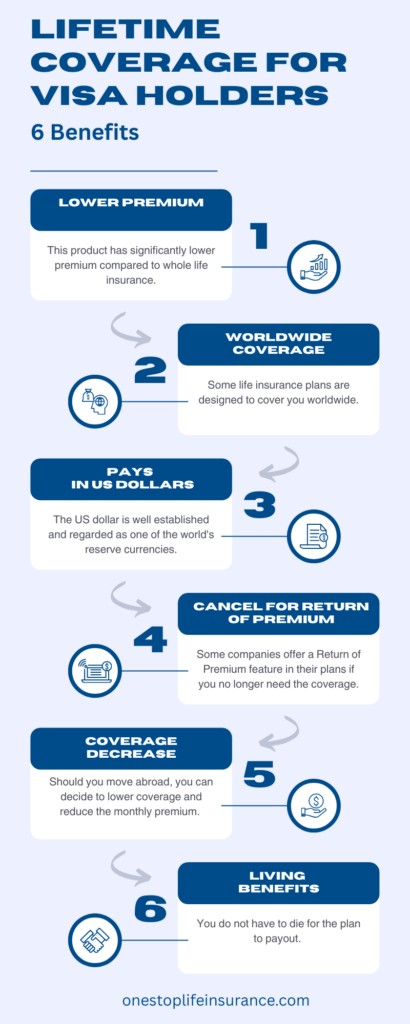
The infographic below highlights the six core benefits of lifetime life insurance for visa holders, including lower premiums, portability, return of premium options, and living benefits.
Infographic: 6 Benefits of Lifetime Life Insurance for Visa Holders
Lower premiums compared to whole life
We wanted to start with that. Unlike whole life insurance, guaranteed universal life insurance has significantly lower monthly premiums while providing guaranteed lifetime coverage with a bit more flexibility. You are able to decide until what age you want the plan to be guaranteed. Some companies offer lifetime guarantees up to age 95, 100, 105, 110, or 121. When working with clients, we will recommend a minimum guarantee to age 100 or 105.
Portability/worldwide coverage
One of the most common concerns we hear from visa holders is what happens to their life insurance if they move abroad. Lifetime life insurance policies are designed to cover you worldwide.
If you move outside the US, the policy can remain active as long as it is associated with a US address and premiums are paid from a US bank account.
During the application process, carriers will ask about foreign travel and whether you plan to move abroad within the next two years. This must be disclosed, as it can affect eligibility.
Takeaway: Lifetime life insurance remains portable and valid worldwide when properly structured.
We have also created a separate guide on how to file a life insurance claim should someone pass away abroad.
Pays the death benefit in US dollars
The US dollar is well established and regarded as one of the world’s reserve currencies. Many world banks hold assets in USD as a part of foreign exchange reserves. This provides an extra layer of confidence in the plan.
Can cancel for a full return of premium
Some companies offer a Return of Premium feature in their plans. If you no longer need the coverage or your goals have changed, you can cancel the insurance for a full refund of the premiums paid. Most often this feature is available after 20 years of having the plan. Should you decide to cancel the policy, you will have full control of what you want to do with the returned premium: you can supplement your retirement, cover medical expenses, etc.
Some carriers allow for coverage decreases
This adds to the flexibility and customization of the plan. Life insurance needs change over time. Typically, the need for life insurance decreases as we age. If at some point you find yourself no longer needing as much coverage, you can decrease the coverage amount. This will reduce the monthly premium, making this plan even more affordable.
This is very beneficial for clients, who might move abroad and opt in to lower the coverage in an exchange of a lower payment.
Living benefits may be available
Living benefits in life insurance or accelerated benefit riders allow you to access a portion of the death benefit while still alive if diagnosed with a qualifying illness. Companies list these conditions in their policy packets and refer to them as triggers. In other words, you do not have to die for the policy to pay out. This can be crucial for many families in the event of a medical diagnosis, especially later in life.
It is a good time to mention that some companies allow for the insured to be eligible for this benefit, even if they live abroad. Please see life insurance with living benefits for visa holders.
Is Lifetime Life Insurance the Same as Whole Life Insurance?
Lifetime life insurance and whole life insurance both provide permanent coverage, but they are structured very differently. Lifetime coverage focuses on guarantees and affordability, while whole life emphasizes cash value growth at a higher cost.
Here are some of the key points and how the two compare:
| Criteria | Lifetime Coverage | Whole Life |
|---|---|---|
| Coverage guarantees for lifetime | Yes | Yes |
| More flexible options in duration | Yes | No |
| Build cash value | Very minimal | Yes |
| Cost | Lower cost | Higher cost |
| Available to visa holder | Yes | Yes |
| Set return of premium feature | Yes | No |
Frequently Asked Questions About Lifetime Life Insurance for Visa Holders
Can visa holders get lifetime life insurance in the US?
Yes. Lifetime life insurance is available to many visa holders living in the US. Eligibility depends on the insurance company and factors such as visa type, length of time in the US, intent to remain, financial ties, and health. Each carrier has different underwriting guidelines, and not all companies offer lifetime coverage.
Is lifetime life insurance the same as whole life insurance?
No. Lifetime life insurance, often structured as guaranteed universal life, focuses on providing lifelong guaranteed coverage at a lower cost. Whole life insurance also provides permanent coverage but is significantly more expensive and is designed to build cash value, while lifetime coverage is primarily focused on guarantees and affordability.
What happens to my life insurance if I move outside the US?
Lifetime life insurance policies are designed to provide worldwide coverage. The policy can remain active if it is associated with a US address and premiums are paid from a US bank account. During the application process, carriers require disclosure of foreign travel or plans to live abroad, as this may affect eligibility.
How long does lifetime life insurance last?
Lifetime life insurance can be guaranteed up to a specific age, depending on how the policy is designed. Common guarantee periods include age 95, 100, 105, 110, or 121. The policyholder chooses how long they want the coverage to be guaranteed.
What visa types are eligible for lifetime life insurance?
Commonly eligible visas include H1B, H4, TN, O-1, L1, P, and K visas. Eligibility varies by insurance carrier, and other visa types may also qualify depending on the company’s guidelines.
Which Visa Types Are Eligible for Lifetime Life Insurance?
Many visa holders are eligible for lifetime life insurance, though requirements vary by carrier. In most cases, visa type is reviewed before health during underwriting.
Here are some of the most common visas eligible for lifetime life insurance:
If you are living in the US under an F-1 visa (international student) or with any different visa, simply reach out to us. We have contracted with over 20 different carriers to match you with a plan you are eligible for.
What Are the Requirements to Qualify for Lifetime Life Insurance as a Visa Holder?
Life insurance companies evaluate visa holders based on length of stay in the US, intent to remain, financial ties, and health. These factors help carriers determine eligibility and pricing.
Length of stay in the US
Most carriers require visa holders to have lived in the US for at least three years to qualify for the best rates.
If you have been in the US for:
- 1–3 years, coverage is still available, though some carriers may limit the best health class
- 12+ months, certain companies may still approve you at top rates
- Under 12 months, you may be considered a non-resident for insurance purposes
Takeaway: Length of stay directly impacts eligibility and pricing.
Is your intention to remain permanently in the US
Many carriers now ask whether your intent is to remain permanently in the US if given the opportunity. While they understand circumstances can change, intent is an important underwriting factor.
You will also be asked if you plan to travel or reside outside the US within the next two years.
Takeaway: Clear intent to remain in the US improves underwriting outcomes.
Do you have financial ties to the US
Carriers want to confirm that US-based coverage makes financial sense. They may review:
- Employment with a US company
- Home ownership or rental history
- Tax filing history
Stronger financial ties help support eligibility.
Takeaway: Financial connections to the US strengthen your application.
Possible medical exam
Life insurance carriers typically will require a medical exam when reviewing one’s application. More companies are leaning toward accelerated underwriting options. In other words, they are trying to approve a life insurance application without the need of a medical exam. Unfortunately, some companies will not have the no-exam option available to visa holders. We have dedicated a separate guide for no-exam life insurance for visa holders.
Our favorite strategy on setting up lifetime coverage for visa holders
Our favorite way to use lifetime life insurance for visa holders is by combining it with term insurance. This approach provides strong protection at a significantly lower cost.
Let us give you an example of why this is really a great strategy:
If you are in your 40s, have a mortgage, family, and small kids. You have people depending on you financially. This is the phase of your life when you need the most death benefit protection. But guess what, this is temporary. As we mentioned above, over the years, we will need less and less coverage.
If we determine your family will need approximately $1,000,000 for the next 15 to 20 years to maintain the same lifestyle you are able to provide today, we have 3 different ways to secure it.
Option 1: Get $1,000,000 – 20-year term.
If you are in good health and do not smoke, you can expect a monthly premium of around $50.00. Very reasonable and affordable given the amount of insurance. This will give you the peace of mind that your family will be protected for the next 20 years should you suddenly pass away.
However, what about after the 20 years? It is very likely that you might need some insurance beyond that. So we go into the other option:
Option 2: Lifetime guaranteed coverage for $1,000,000
This way you know that you will not outlive your coverage, and you will know that this plan will pay out.
The problem with it is the monthly premium. You can expect to pay around $500 per month for lifelong coverage guaranteed to age 110. If you can comfortably afford $500 per month, this could be a good fit.
You know that you will leave $1,000,000 to your family, potentially income tax-free.
However, not many people can afford a $500 monthly premium. So this is where the last option will come in:
Option 3: Combine term insurance with lifelong coverage.
- $750,000 term insurance for the next 20 years for a monthly premium of $40
- $250,000 lifelong coverage till age 110 – $139
In option 3, you will have a protection of a combined $1,000,000 in the next 20 years with a monthly premium of less than $200. After the 20 years, you will have the option to continue with the lifelong coverage and maintain a death benefit of $250,000
Instead of choosing only term or only lifetime coverage, we often recommend:
- Term insurance to cover high-income and family needs
- Lifetime coverage to ensure permanent protection
This strategy provides flexibility, affordability, and long-term options.
Takeaway: Combining term and lifetime coverage offers maximum protection with lower overall cost.
To summarize
Lifetime life insurance is available to visa holders and can provide guaranteed coverage for life when designed properly. It offers long-term protection, potential living benefits, and, in some cases, a return of premium option.
Not every carrier offers lifetime coverage, and not all plans are built the same. For visa holders, eligibility and underwriting rules vary significantly by company.
That is why it is important to work with an agency specializing in life insurance for foreign nationals. With the right structure, lifetime coverage can remain portable, affordable, and reliable, even if your plans change in the future.
We hope you find this information helpful, and we are looking forward to working with you.
Have a great rest of your day.